Free workflow walkthrough
How to make AI claim labels enforceable during bug triage
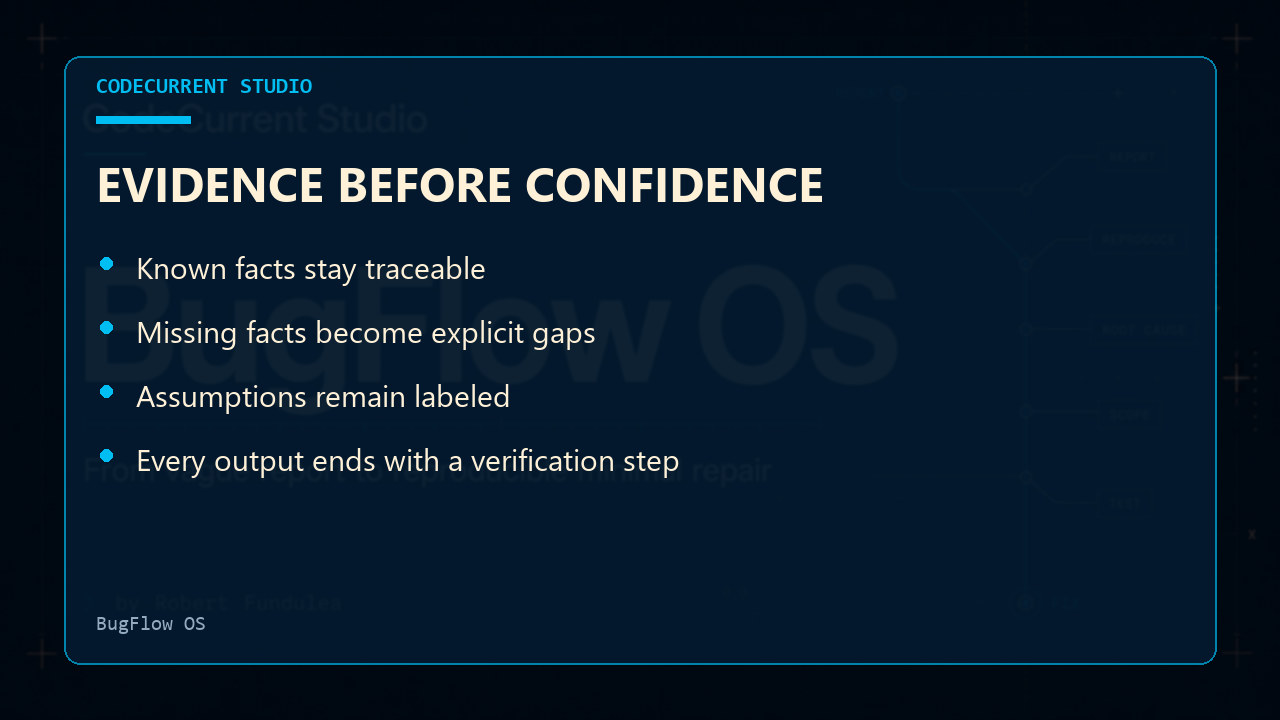
Claim labels only improve reliability when they control what can happen next. A model saying “unknown” is not useful if it immediately continues to a confident fix. This workflow makes material unknowns and inferences explicit blockers, then periodically checks whether “verified” labels really have the observation they claim.
01 / Scenario
Start with the boundary, not the model.
A report says that a physical appointment slot was double-booked near a daylight-saving change. The word “timezone” appears in the ticket, but that is not evidence of a conversion defect. The workflow has to distinguish the observed symptom from the suspected path, the mechanism, and the repair boundary before anyone edits scheduling behavior.
An AI assistant may organize supplied facts, suggest questions, and draft a bounded artifact. It cannot turn an unverified claim into repository evidence, stakeholder approval, a test result, or production truth.
02 / Workflow
A repeatable sequence.
- 01
Create a claim register before proposing a cause
List every consequential statement: reported symptom, affected path, environment, suspected mechanism, working control, and proposed repair. Give each one a status: supplied, verified, inferred, or unknown.
- 02
Attach evidence to every verified claim
A verified label needs a concrete observation: a reproduction log, code path, test output, trace, configuration value, or approved decision. A label without supporting evidence is an inference in disguise.
- 03
Define the gate
Mark the claims that must be verified before a repair can proceed. For a root-cause fix, that normally includes the failing condition, the mechanism, and the authority boundary where the fix belongs.
- 04
Use a control path to reduce uncertainty
Compare a nearby path that behaves correctly. The contrast can either support a mechanism or expose a new unknown; it should not be used to make the original ticket sound more certain than it is.
- 05
Spot-check model verification labels
Periodically sample claims marked verified and follow their evidence links. Track relabelled claims so a model that calls guesses verified does not quietly create false confidence.
- 06
Only then issue a repair packet
Produce the minimal fix boundary, regression cases, remaining unknowns, rollout signal, and next verification step. If a material claim remains open, return a conditional plan instead of a completed diagnosis.
03 / Fictional worked excerpt
What a bounded output looks like.
The table below condenses a fictional example included for demonstration. It is not a customer result, production test, approval, or performance claim.
A user observed a double booking while rescheduling near a daylight-saving transition
The fictional reproduction matrix shows reschedule allows a collision while a new-booking control blocks it
The reschedule path bypasses timezone normalization until its code path or trace is observed
Do not implement a root-cause repair while the failing mechanism remains inferred or unknown
04 / Failure modes
Where otherwise plausible AI output goes wrong.
- Using labels as decorative prose while allowing the workflow to proceed unchanged
- Calling a claim verified without pointing to the observation that supports it
- Treating the ticket’s vocabulary as proof of the root cause
- Expanding a narrow repair into a global scheduling rewrite before adjacent paths are checked
05 / Read-only checklist
Use this before calling the artifact complete.
- Every material claim has one status
- Every verified claim has a concrete evidence reference
- Unknown and inferred root-cause claims block the repair step
- A nearby working control is recorded or explicitly unavailable
- A sample of verified claims is rechecked
- The output separates a supported repair from remaining verification
- Regression cases protect the original invariant and a nearby control
This checklist is intentionally read-only: it helps you inspect a workflow without exposing the full native skill files, portable prompts, templates, or the bundle-exclusive orchestration skill.
Use the full system
BugFlow OS
Move from symptoms to a reproducible case, evidence-supported root cause, minimally scoped fix, and regression protection.
Questions
Using AI without hiding uncertainty.
Can an AI model decide that a claim is verified?
It can classify evidence that you provide, but the verification label should point to a concrete observation and remain subject to human review. A model-generated label is not a substitute for a reproduction, trace, test result, or code inspection.
Which claims should block a fix?
Claims that determine the repair boundary or safety posture: the failing condition, the supporting mechanism, the system authority being changed, and any prerequisite needed to verify the regression. Smaller open facts can remain in a conditional plan when they do not change those decisions.