Free workflow walkthrough
How to turn an idea into a software specification
A useful specification is not a longer version of the original idea. It is a record of decisions: who the first user is, what changes for them, where the system boundary sits, what is deliberately excluded, and what evidence will show the release works.
01 / Scenario
Start with the boundary, not the model.
Suppose a clinic says, “Send appointment reminders from our existing CRM in two weeks.” The request sounds small, but provider choice, consent evidence, retry rules, timezone behavior, cancellations, and duplicate protection all affect the design. The workflow below keeps the useful boundary small without pretending those choices are already settled.
An AI assistant may organize supplied facts, suggest questions, and draft a bounded artifact. It cannot turn an unverified claim into repository evidence, stakeholder approval, a test result, or production truth.
02 / Workflow
A repeatable sequence.
- 01
Frame the change in one page
Name the primary user, trigger, desired outcome, system of record, V1 boundary, and non-goals. If the frame cannot fit on one page, the release is probably carrying more than one product decision.
- 02
Build an evidence register
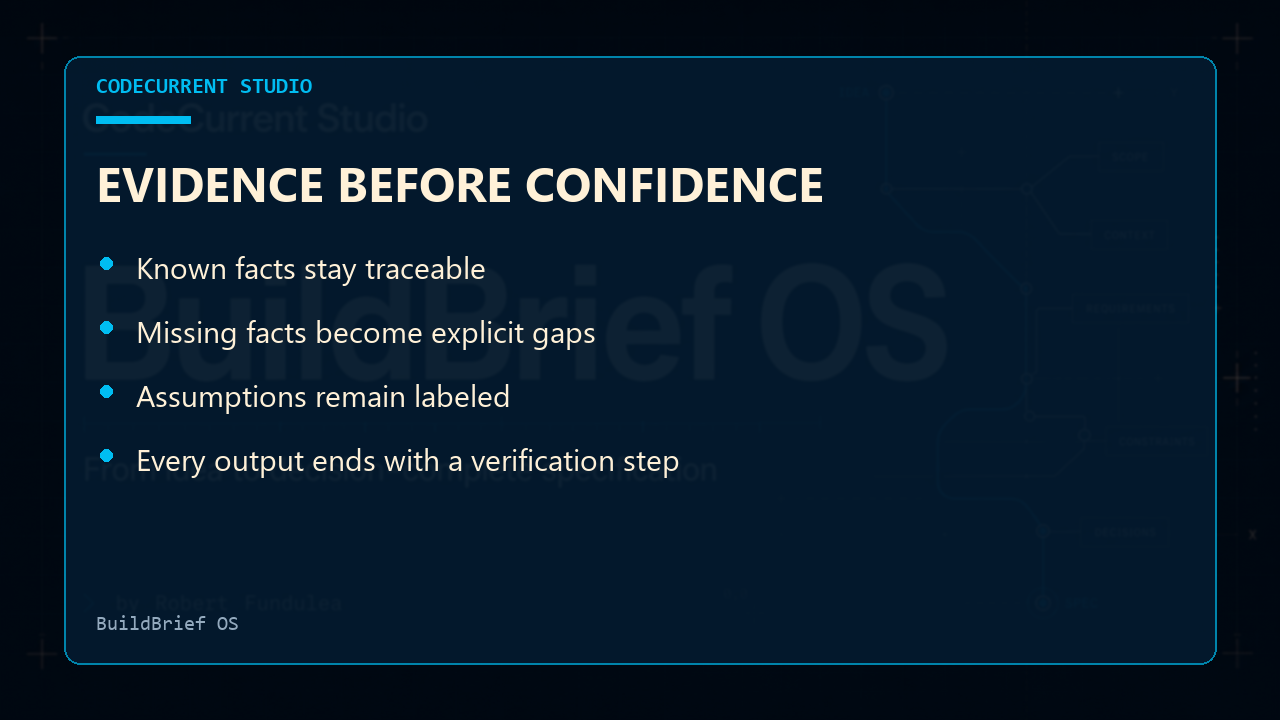
Classify each important statement as supplied fact, verified evidence, inference, assumption, or unknown. A model can help structure the register, but it cannot promote an assumption into stakeholder approval.
- 03
Map the user and system flow
Write the happy path and the consequential branches: cancellation, invalid data, duplicate jobs, external-provider failure, and daylight-saving transitions. Keep actions and system state changes separate.
- 04
Resolve or expose material decisions
Make the decision, identify an owner and deadline, or mark the item as a blocker. Do not hide unresolved choices inside implementation tasks.
- 05
Write requirements and acceptance together
Each requirement should lead to observable acceptance evidence. For the reminder example, “one reminder per appointment” needs an idempotency scenario, not only a sentence in the spec.
- 06
Plan vertical slices
Sequence work so each slice proves a behavior: scheduling, cancellation, provider failure, visibility, and release controls. Avoid task lists that separate every frontend, backend, and database action from the user outcome.
03 / Fictional worked excerpt
What a bounded output looks like.
The table below condenses a fictional example included for demonstration. It is not a customer result, production test, approval, or performance claim.
Email only; existing CRM remains authoritative; no rescheduling or marketing
A cancelled appointment produces no provider call
Provider, consent, retry ceiling, and approved copy remain open
Review with reception and test anonymized timestamps before provider selection
04 / Failure modes
Where otherwise plausible AI output goes wrong.
- Starting with architecture before the user and outcome are fixed
- Treating model-generated market or stakeholder statements as evidence
- Writing requirements without failure states or observable acceptance
- Letting unresolved decisions disappear into a generic backlog
05 / Read-only checklist
Use this before calling the artifact complete.
- One primary user and trigger
- System of record and authority boundary
- Explicit V1 and non-goals
- Evidence register with unknowns
- Happy path plus consequential failures
- Decision owner for each blocker
- Acceptance evidence for every material requirement
This checklist is intentionally read-only: it helps you inspect a workflow without exposing the full native skill files, portable prompts, templates, or the bundle-exclusive orchestration skill.
Use the full system
BuildBrief OS
Frame the product, expose consequential unknowns, map the user flow, resolve decisions, and define acceptance before implementation begins.
Questions
Using AI without hiding uncertainty.
How detailed should a V1 software specification be?
Detailed enough for design, engineering, and review to make the same material decisions. It does not need to predict every implementation detail, but it must expose authority boundaries, failure behavior, non-goals, and acceptance evidence.
Can AI write the entire specification from one sentence?
It can draft structure and questions, but it cannot know missing stakeholder decisions, private system behavior, or real evidence. A reliable workflow asks for those facts and labels what remains unresolved.