Free workflow walkthrough
A practical software release-readiness workflow
Release readiness is not the absence of known bugs. It is a reasoned decision about a precise artifact, supported by evidence that matches the change's likely and harmful failure modes, with owners and recovery prepared before exposure grows.
01 / Scenario
Start with the boundary, not the model.
Consider a database migration that introduces a required column while old and new application versions overlap. A single migration that adds the column, backfills, and enforces the constraint may be easy to describe but hard to reverse. An expand/backfill/contract sequence makes compatibility and stop conditions visible.
An AI assistant may organize supplied facts, suggest questions, and draft a bounded artifact. It cannot turn an unverified claim into repository evidence, stakeholder approval, a test result, or production truth.
02 / Workflow
A repeatable sequence.
- 01
Identify the exact change artifact
Tie the review to a commit, build, migration set, configuration, and dependency state. Release evidence that points to an earlier artifact is not evidence for the candidate.
- 02
Assess risk with reasons
Look at blast radius, reversibility, data integrity, compatibility, security, operational novelty, and observability. Record why a risk is high or low and which control would lower it.
- 03
Allocate test depth
Build a matrix across changed paths, integration boundaries, failure behavior, and controls. Test depth should follow risk—not an equal checklist for every component.
- 04
Define go/no-go evidence
Name each prerequisite, acceptable result, evidence location, owner, and freshness. Unknowns should produce a conditional decision, not a confident green status.
- 05
Stage the rollout
Use cohorts or reversible gates where the system supports them. Define health signals, observation windows, and hold/stop thresholds before release begins.
- 06
Prepare recovery
Document who can execute rollback, exact steps, validation after recovery, and the point after which forward recovery is the only safe option.
03 / Fictional worked excerpt
What a bounded output looks like.
The table below condenses a fictional example included for demonstration. It is not a customer result, production test, approval, or performance claim.
Expand, dual write, resumable backfill, read switch, enforce, contract
All writers compatible and the archived mismatch query returns zero
Replication lag, mismatch, or error rate exceeds agreed thresholds
Engine, table size, write rate, lock window, and operators
04 / Failure modes
Where otherwise plausible AI output goes wrong.
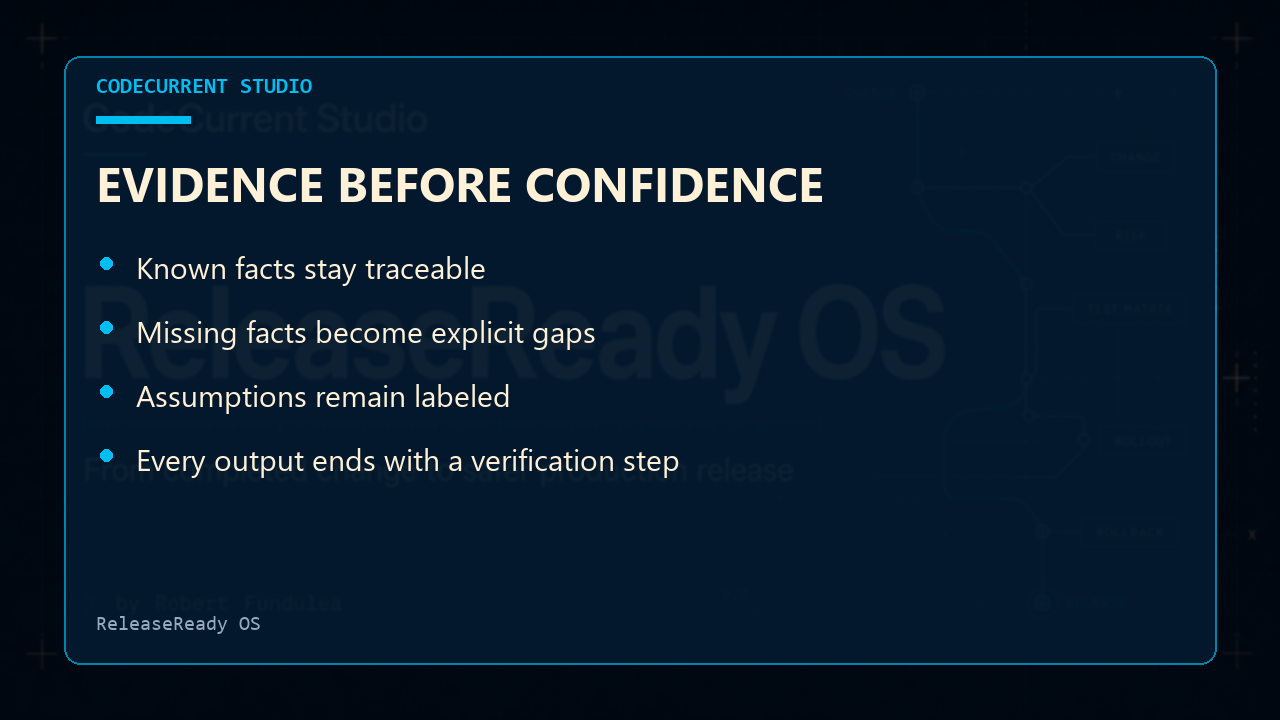
- Approving a release without identifying the exact artifact
- Calling a change low risk because the diff is small
- Writing rollback after production exposure begins
- Using thresholds that were never agreed or cannot be observed
05 / Read-only checklist
Use this before calling the artifact complete.
- Exact release artifact
- Explained risk register
- Risk-weighted test matrix
- Evidence owners and freshness
- Staged exposure plan
- Health signals and stop conditions
- Executable recovery with irreversible limits
- Release notes grounded in verified facts
This checklist is intentionally read-only: it helps you inspect a workflow without exposing the full native skill files, portable prompts, templates, or the bundle-exclusive orchestration skill.
Use the full system
ReleaseReady OS
Review what changed, assess risk, allocate test depth, prepare rollout and rollback, and write release notes from verified facts.
Questions
Using AI without hiding uncertainty.
What belongs in a release-readiness review?
The exact artifact, change intent, risk rationale, test evidence, operational prerequisites, rollout stages, health thresholds, recovery steps, owners, and unresolved facts.
Does a green CI pipeline mean a release is ready?
No. CI is one evidence source. It may not cover production configuration, data migration behavior, observability, operator readiness, staged rollout, or recovery.